
The word Tashi Gomang means “Stupa of Multiple Auspicious Doors”. In the Buddhist world, a Tashi Gomang is the Third of the Eight Stupas representing the eight important facets of Lord Buddha Shakyamuni’s life. This stupa commemorates Lord Buddha’s first teaching at Deer Park in Sarnath (Varanasi), India.
The Third Stupa of the Wheel of Dharma is known as a Tashi Gomang Stupa or Stupa of Many Doorways. It is also referred to as Kubum meaning ‘one hundred thousand holy images’. With a maximum of 108 doors, the doorways adorning the steps symbolize the opening of the doorways of the Dharma. These doors also signify that the teachings will spread far and wide.

There are no written records as such about the Tashi Gomang tradition in Bhutan. However, oral traditions and mythical narratives provide several stories relating to the origin of Tashi Gomangs in Bhutan. The most prevalent story attributes its origin to the Great Zhabdrung Ngawang Namgyel (1594-1651), the Unifier of Bhutan as a Nation State.
When Punakha Dzong (fortress) was being built, it is said that the local deities and spirits in the area greatly assisted and served Zhabdrung. While the timber and stone needed for the Dzong were offered by Khachepa, the local deity of Phochhu river, Gon Dragpa and Ritsen Dorje Thogyed Tsel revealed a quarry offering excellent stones and boulders. A mermaid from the confluence of the two rivers, Phochhu and Mochhu, also offered seasoned wood, which was used for making pillars. Confoundingly the following morning, whatever work was done during the day was soon demolished at night by the evil forces. A Dakini (Goddess), Dechen Gyem appeared before Zhabdrung and told him that using a Tashi Gomang would subdue the demons and construction could resume.
Zhabdrung summoned Zow Balip, a woodworker from Balingkha village, who was known to be unmatched in his carpentry skills. He was believed to be the incarnation of the divine craftsman Vishvakarma. Zow Balip came with a bucket of milk and a basket of red berries, which Zhabdrung thought was highly auspicious, symbolic of the growth of the red- robed monastic community.
Zhabdrung made him sleep in his presence for three consecutive nights. Through Zhabdrung’s spiritual power, he was taken to Ralung Monastery, the main seat of the Drukpa Kagyud School in Tibet, and to the Zangdopelri palace, the Copper-Colored Mountain Paradise of Guru Padmasambhava, in order to see the architectural designs of these sites. After Zow Balip recounted his dream, Zhabdrung instructed him to build Punakha Dzong in the image of the monastery in Ralung, and a Tashi Gomang resembling the Zangdopelri palace. Subsequently, Zhabdrung named Zow Balip as Trulpai Zow, or the divine being who had taken the incarnation of an Architect.

Zhabdrung imprinted several Buddhist figures on clay molds to be installed in the Tashi Gomang. The best painters and blacksmiths were summoned to ornament and apply the final touches. A Vajra or dorji made by a legendary blacksmith was put inside the Tashi Gomang as the central sacred relic. This Tashi Gomang was called Zhungba and is said to hold images of Zhabdrung and Zow Balip on the right and left sides of the pinnacle. Zhabdrung personally presided over the consecration of Zhungba, and it was later installed in the Utse (tower) of Punakha Dzong.
When Punakha Dzong was completed, a great celebration took place. Zhabdrung’s patrons from all across Bhutan joined the joyous occasion with heaps of offerings. Since then, Punakha was referred to as ‘Pungthangka’ or the ‘ground of heaps’, and the dzong, ‘Dewachenpoi Phodrang’ or the ‘Palace of Great bliss’. All sacred relics including the Rangjung Khasarpani, the holy vertebra relic of Buddha Khasarpani or Avalokiteshvara (Budha of Compassion),was installed in Punakha Dzong along with the Tashi Gomang.
Every year, to this day, during the Punakha Dromche and Tshechu (yearly religious festivals), the construction of the Dzong is reenacted. Zhabdrung considered that Tashi Gomangs could be used as a tool to preach the teachings of Buddha during public gatherings, especially in remote rural areas. Thus, he is believed to have started the tradition of wandering Lam Manips (one who chants prayers) carrying Tashi Gomangs and reciting mani (chants) for the masses who are not able to visit the Zangdopelri Lhakhang (temple). Later on, several Tashi Gomangs were commissioned in different monasteries for the benefit of the people.
Another source recounts that when Punakha Dzong was ravaged by fire in 1750, the Utse may have been destroyed in the fire. It was not until the reign of Zhabdrung Jigme Drakpa (1791-1830), the Fourth Mind Incarnation of Zhabdrung Ngawang Namgyel that any Tashi Gomangs were constructed. While the First Zhabdrung introduced the tradition, the Fourth ensured its revival. Therefore, both have played a major role in propagating the tradition of Tashi Gomang.
While the above two stories are more enduring, there is another tale related to the origin of the Tashi Gomang in Bhutan which is less familiar. This story attributes the origin of Tashi Gomang to a Gomchen (lay priest) named Drangsong who lived in Tsangchen, a mythical place of gods. ‘Drangsong’ literally meant detachment and rightly so as he was a man who had realized the greater paradox of life by practicing detachment. Hearing of Gomchen Drangsong, the King of Tagzhinor wanted to test him. The King asked for his daughter, Khandom (Dakini) Zhungkinim’s hand in marriage. Gomchen Drangsong surrendered his daughter to the King and as she left, Gomchen Drangsong was overcome with great sadness. He climbed a hill to see her depart and as they disappeared into the distance, he climbed ever higher to get a better view until he fell and died. When Gomchen Drangsong died, a Tashi Gomang emerged from his body. This Tashi Gomang flew down to Varanasi where Lord Buddha was preaching. It was the five Khandoms (Dakinis/ Goddesses) of King Tegor, the King of the gods who instructed Lord Buddha to use the Tashi Gomang that emerged from Gomchen Drangsong’s body, to eradicate all suffering including the three poisons namely greed, anger, and arrogance.

Courtesy: B&F Shaw Collection (1982)
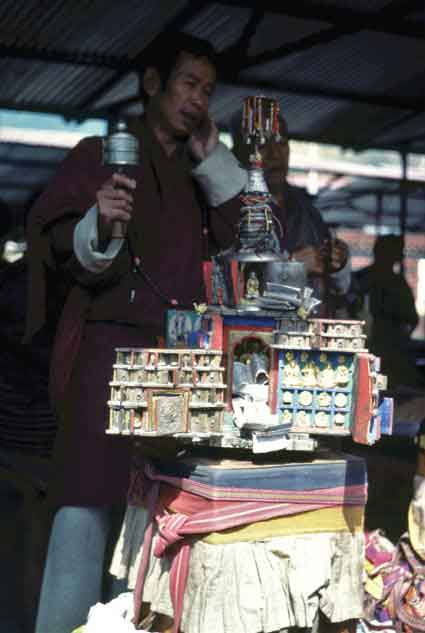
Courtesy: B&F Shaw Collection (1982)
Just the sight of a Tashi Gomang is equivalent to seeing all the sacred nyes (holy sites) that were brought together by Lord Buddha for the benefit of people to cleanse all sins. It is a source of accumulating merit and it is said that the older the shrine, the more blessings it contains.
The Tashi Gomang culture is unique to Bhutan. It represents a meticulous craftsmanship woven with abundant history and folklore making it an invaluable component of our rich cultural heritage that we would do well to embrace and carry forward.
For the first time in history, 29 of the known 34 Tashi Gomangs in Bhutan were exhibited at the Royal Textile Academy for the exhibition titled “Tashi Gomang: A National Treasure of Bhutan” from November 2016 – February 2017.

Pema Chhoden Wangchuk
Pema Chhoden Wangchuk is a Senior Curator at the Royal Textile Academy of Bhutan (RTA). Prior
to joining the RTA in 2010, she worked at Museum Reitberg in Zurich, Honolulu Academy of Arts in Honolulu and Wing Luke Museum in Seattle.
