
Travels in Kurtoe, Lhuentse
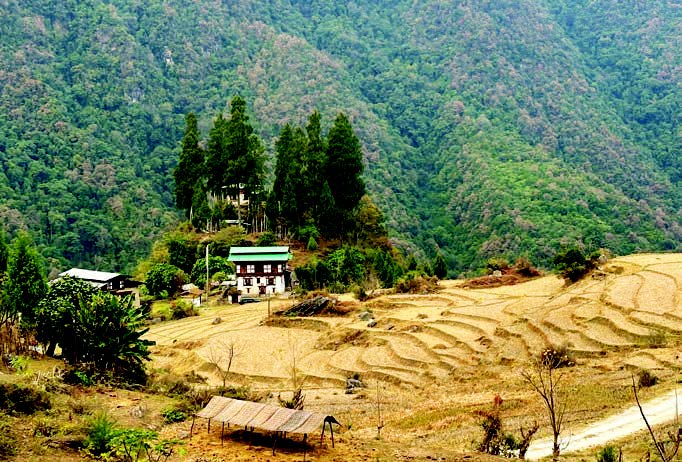
Of the 20 dzongkhags that makes up present day Bhutan, my maternal ancestral village of Thuenpay in the far north-eastern corner of Lhuentse dzongkhag remains isolated and unknown.
To sign off the year 2024 on an adventurous note, my husband Sangay and I decided to make a short trip there. This would be his first visit and mine in 40 years. We did not know what we would find on our arrival but the excitement of the moment and planning for the trip took away all doubts and misgivings.
On the two-day journey from Thimphu in the west to Dungkar village, we clocked in a total distance of 500 kilometers in about 15 hours of driving time. As it was not wise to drive directly to Thuenpay on treacherous ice-covered roads in wintertime, we spent a night at the Chumey Nature Resort in Gyetsa, Bumthang.
The drive along the national highway to the east took us through some of the most spectacular landscapes. From alpine forests to terraces of cultivated fields and small clusters of village settlements, we climbed up to the highest elevation of Thrumshing La (3780 metres), a pass connecting the central and eastern regions. Narrow deep gorges cut into continuous chains of hills that stretched far into the distant horizon.
From the district capital of Lhuentse Dzong, we took the 40 km unpaved road going north to Dungkar village. Before its completion in 2008, I remember the old days when we walked and traveled on horseback for five days from Mongar to our village. I still carry memories of camping under the stars.
The living conditions of people in Thuenpay and neighboring villages have improved significantly with basic health services and education being provided free of cost by the government. When electricity arrived in 2011, farming and household chores became easier. Electric kettles and rice cookers were the rage in my village at one time and soon television sets followed with satellite dishes on rooftops becoming a familiar sight. Where once farmers plowed the fields using oxen, now they have power tillers. My 73-years-old aunt Aum Zangmo proudly uses her rice milling machine at harvest-time.
One evening as I watched a cowherd drive his cows home along the farm road that ran around the villages like a pale yellow ribbon, I wondered what lay in store for Thuenpay and neighboring villages in the future. For many years, they have been grappling with the challenges of rural-urban migration. Many families leave for towns in search of jobs and better opportunities leaving their houses empty for months and even years in many instances. Although it is a phenomenon plaguing many other places in the country, I feel if the trend continues it is a setback from which they will never recover.
As more fields are left fallow each year with the shortage of farm labor, these fields become forests over time. Attacks by wild animals on crops and livestock have become common. I heard stories of troops of monkeys causing mayhem as they brazenly raid corns of cob drying in the attics of houses and fruit from kitchen gardens. Sangay was curious why we never heard the barking of dogs during our stay and he later learned leopards had killed all the dogs in the village.
On a brighter note, my ancestral home region is a land blessed by many places of historical and religious interest. I will highlight some of them here.
Dungkar Choeje Lhakhang
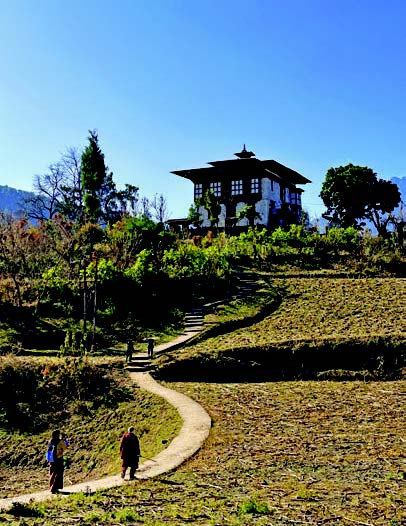
Perched on a ridge shaped like a conch shell, the house of Dungkar Choeje in Dungkar village is of utmost historical importance. It is the ancestral birthplace of the Wangchuck Dynasty. Jigme Namgyel, the father of the first king, was born here in 1825 and left home when he was 15 to eventually become the Trongsa Penlop and the 51st Desi. With funding from the government, the Choeje Lhakhang hosts several annual events like Gurdra held on the 28th and 29th days of the 2nd month of the Bhutanese lunar calendar and the Goempo Jatsha taking place from the 30th day of the 10th month until the 4th day of the 11th month. This is followed by the Dungkar Tshechu celebrated from the 8th to the 11th day of the 11th lunar month. During the tshechu, Terchams (treasure dances) believed to have been choreographed by Terton Pemalingpa himself.

Dungkar Naktsang
A short walk up the hill from Dungkar Choeje Lhakhang is the stately manor of Dungkar Naktsang also known as Jigme Namgyel Naktshang and Khetangbi Naktsang. On his return from Gangtey Goenpa in western Bhutan where he lived for a time, Pila Goenpo Wangyel, the father of Jigme Namgyel lived here. His daughter Ashi Tshewang Dem rebuilt and expanded the imposing building in honor of her brother who had become the powerful Trongsa Penlop. Pila Goenpo Wangyel was a direct descendant of the 15th century treasure revealer Terton Pemalingpa.
Göeshpang Lhakhang
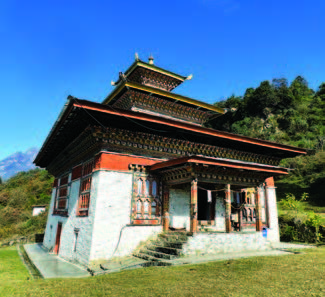
One of the most sacred temples in our area, Goeshpang Lhakhang was believed to have been built by Terton Pema Lingpa in 1501. According to popular legend, Pemalingpa who was fleeing persecution from Ney village had sought shelter in Tangrung. The people of Tangrung treated him with deep devotion and respect and offered him a piece of land to build a temple. While searching for a suitable site, he saw a vulture flying towards a ridge that resembled the same posture of the bird in flight. He decided to build the temple on that spot and it received the name of Vulture’s Feather Plains temple. It houses an exquisite statue of Guru Padmasambhava sculpted by none other than Pema Lingpa himself.
Kunzangling Lhakhang
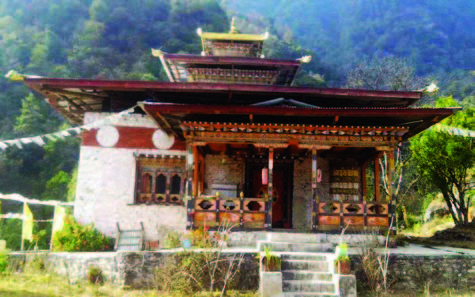
On the opposite side of the Kurichu river from our village is Kunzangling Lhakhang. It was established by the renowned Nyingma master Kuenkhen Longchen Ramjam who traveled to Bhutan from Tibet in the 14th century to teach the Great Path of Perfection (Dzogchen) to his followers. Kunzangling Lhakhang is one of the eight Lings or spiritual centers he set up in Bhutan. Besides housing the usual images of the Buddha, Guru Padmasambhava and Zambhala (God of Wealth), one can see the footprint of Longchenpa on a rock in his tiny hermitage.

Rinchen Bumpa
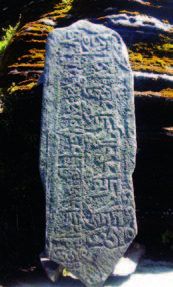
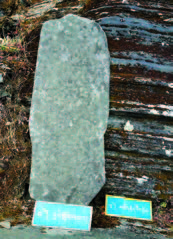
Perched high on a cliff above the Kurichhu is Neychhen Rinchen Bumpa (Vase of Jewels), a sacred site of pilgrimage in the Kurtoe region. Believed to have been visited by Guru Padmasambhava in the 8th century and where his spiritual consort Yeshe Tshogyel meditated in a cave, there is a radiant spiritual energy about this place. Among the numerous rock imprints and sin-cleansing caves, one of the most fascinating relics on the site is the stone tablet of the powerful protector deity Za Rahula of the Nyingma sect. Although the tablet is smooth and blank for most of the day, when the first rays of the sun fall on the carved stone, mystical syllables with the Guru’s mantra Om Ah Hum Vajra Guru Padma Siddhi Hung and other mantras begin to magically appear on the stone.
Serzhong Lhakhang
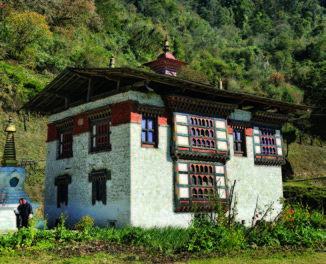
Built in 1933 or 1934, Serzhong Lhakhang or the Temple of the Golden Basin is located in Tangrung village. The renowned Tantric yogi Lama Sonam Zangpo built it to bring peace and prosperity to the villages and to avert disease and famine. The two priceless nangtens (treasures) of the temple are the images of the thousandarmed Chenrezi (Avalokitesvara) and goddess Tara that Lama Sonam Zangpo brought back from Lhasa, Tibet. Beside the main temple, there is a stupa built in memory of his Tibetan master Drubwang Shakya Shri. A small community of nuns from Dungsey Garab Rinpoche’s monastery in Rangjung have been entrusted to look after Serzhong Lhakhang.
Kezang Uden Penjor
She is a journalist by training and a poet at heart. She is from Kurtoe in Lhuentse, the region famous for its weaving and the ancestral home of the nation’s beloved monarchs. She loves history, reading and traveling. mysticdreamer06@gmmail.com
