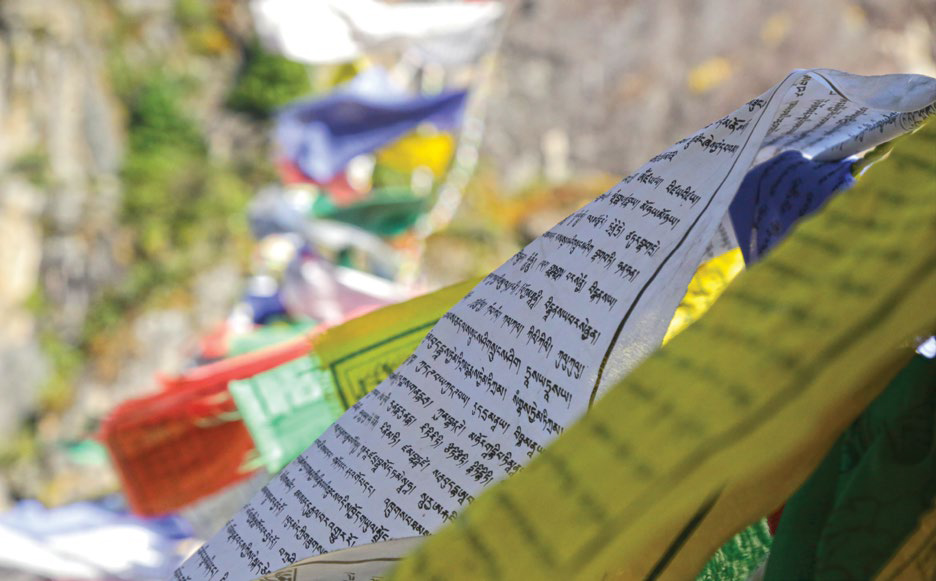
Guru Rinpoche was an 8th century master of tantra. Among his many accolades, he is credited with establishing the first Buddhist monastery in Tibet and introducing the Dharma to Bhutan. In a lineage of formidable Buddhist practitioners and scholars, he was a giant among giants. As a master of such vast spiritual attainment, he conducted innumerable extraordinary feats to subdue forces hostile to the Dharma, enabling the sacred teachings to take root in the Himalayan region, where it molded the culture and established a system that can swiftly lead beings to awaken to reality.
Among these deeds, one of his most celebrated was the subjugation of a malignant force that was obstructing the spread of the Dharma in Bhutan. This manifestation of negative energy appeared in the form of a demon called Myongkhapa who had previously tried to prevent the construction of Tibet’s first Buddhist monastery, Samye.

After the intervention of Guru Rinpoche, Myongkhapa fled Tibet, taking up residence in present-day Trashiyangtse in Eastern Bhutan, where he continued to obstruct the spread of the Dharma.
Now, some sources claim that this demon was not a simple local deity who had adopted deviant views, but a former Buddhist scholar who had fallen under the influence of negative forces – a real-life Darth Vader.
With knowledge of the Dharma and skills in black magic, Myongkhapa would not be easy to subdue. Still, he would be no match for an accomplished master of tantra, and the Guru settled in a cave above a black rock where he was hiding, a site that is currently marked by the Gomphu Kora temple. There, the Guru bade his time, meditating while awaiting the entity’s appearance.
Sensing Guru Rinpoche’s presence, Myongkhapa attempted to escape. At first, he pierced a hole in a black rock to create an escape tunnel. This failed, and so he manifested as a ferocious snake, attacking the Guru. This attempt was also unsuccessful, and instead of being intimidated, Guru Rinpoche transformed into a garuda, swooping down and capturing him in his talons. Defeated, Myongkhapa not only abandoned negative deeds, but also pledged to become a protector of the Dharma.

Evidence of these encounters are still visible today.
The escape passage remains intact, and after being blessed by Guru Rinpoche was transformed into a sacred tunnel popular with pilgrims who crawl through as a means to purify negative karma.
Imprints in the rock bear the scars of the altercation that occurred between the garuda and the snake, while an imprint of the Guru’s thumbprint that was used to authenticate Myongkhapa’s pledge to submit to the Dharma is visible on the wall of the cave.
Gomphu Kora is also a repository of a number of other consecrated objects, such as a longevity vase from Maratika in Nepal. This was concealed in a rock by Guru Rinpoche, from where it emits a trickle of water on auspicious occasions. There is also a garuda egg in the form of a large round orange stone, which is on permanent display inside the temple.

As a revered sacred site, Gomphu Kora receives a steady flow of pilgrims throughout the year, but it is between the 8th and 10th of the second month of the lunar calendar, which falls on 5 to 7 April this year, that the area reaches peak vibrancy with the annual tshechu festival taking place.
In addition to inhabitants from other areas of Eastern Bhutan, the festival draws in over 600 people from Tawang in neighboring Arunachal Pradesh in India, many of whom endure hours of travel on foot amid rugged environs and with entire families in tow.
In addition to the chham mask dances that are de rigueur at tshechus, Gomphu Kora also hosts a number of events that are unique to this festival.
One such activity involves nine men and women attempting to carry a large rock weighing 200 kilograms around a sacred boulder, using only the tips of their fingers. The efforts involved in this activity are believed to create auspicious circumstances for the participants, while restoring the fertility of women who are unable to conceive.
However, the most popular activity is no doubt the night-time circumambulation of the temple. As the sun sets, hundreds of people carrying torches appear like fire flies swarming around a dimly lit temple.

In addition to generating merit, the ceremony serves as a courtship ritual, with the young participants teasing each other, often with insulting words regarding their physical appearance and features.
While this activity may fail to meet the approval of people who have been conditioned by Western-style politically correct values, the ritual is taken in typical good humour by the local population. Moreover, it has no doubt served to mix the gene pool in an area historically isolated from the outside world. In this way, it has contributed to preserving the well-being and strength of the local communities.
How should we consider these tales of demons and saviours? Are they fiction – a Himalayan version of the Lord of the Rings – or fact – a textbook account of historical events? Well, perception depends on karma, and so there is no one fixed way of viewing such events.
Think of a flat piece of wood with four legs as an example. To beings with the karma of adult humans who live in modern societies, it is a table. A child, on the other hand, might see it as a den, a place to hide. An indigenous person in the Amazon jungle may think of it as a boat, while a goat will likely see it as a place to stand. No-one’s interpretation is more correct than another’s. Ultimately, definitions depend solely on our karmically created view and are not fixed.
Similarly, when Guru Rinpoche departed the human realm, some saw him leaving on a divine horse. Others perceived him mingling with swirling clouds of coloured light, while a number of observers reported that he rode away on a lion. As mentioned, perception depends on karma and, in this case, also the depth of the connection with the Guru.
Irrespective of how we see events, the sole aim of any Dharmic activity is to nudge us towards awakening to reality. If these sacred sites and tales of battles with demons help break the rigid, dualist concepts that prevent us from achieving this goal, then they serve their intended purpose. That is sufficient. The rest is merely an academic exercise for historians and scholars.

Shenphen Zangpo
Shenphen Zangpo was born in Swansea, UK, but spent more than 28 years practicing and studying Buddhism in Taiwan and Japan.
Currently, he works with the youth and substance abusers in Bhutan, teaching meditation and organizing drug outreach programs.